
A camera at a checkpoint has no police powers
When checkpoint enforcement becomes social media content, Bangladesh must ask whether the state is protecting citizens—or exposing them to a punishment the law never prescribed.
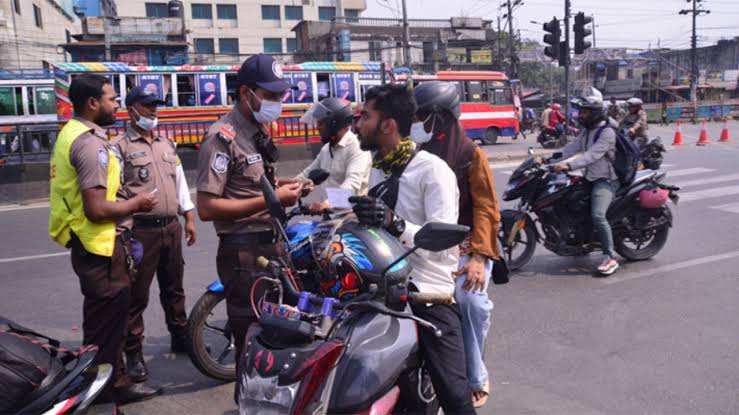
When a motorist is required to answer an officer, the accompanying camera must not acquire the authority to demand an interview. A narrow police protocol could protect citizens without shielding the police from scrutiny.
Abeer Uz Zaman | Investigative journalist
A traffic sergeant asks a motorist to stop. The driver must comply and produce the documents the law requires. Then another person steps forward with a phone, asks where the driver was going, questions the passenger and continues filming after being asked to stop. It looks like one encounter. Legally and ethically, it is two.
The officer exercises the state’s authority. The camera operator does not. Yet a citizen who cannot simply drive away from a checkpoint may struggle to distinguish between questions that must be answered and questions asked for a Facebook audience. That is the problem Bangladesh’s police leadership has yet to resolve consistently.
The scenes are familiar. bdnews24.com’s June 2025 investigation described two women stopped at Hatirjheel without helmets. They reportedly pleaded not to be filmed, while cameras followed them as they attempted to shield their faces. More than seven years earlier, a Prothom Alo report described a police-recorded video of a woman being harassed at a Rampura checkpost; three officers were subsequently suspended, according to that report. This October, The Business Standard examined footage from raids and the publication of detainees’ personal details. These are different incidents, involving different actors. Their recurring question is the same: who decides what part of an enforcement encounter becomes a public spectacle?
The media have already reported extensively on intrusive filming, including in The Daily Star. Repeating that it is humiliating offers little new. The more consequential question is administrative: what can a police commissioner order officers to do tomorrow, within powers they already possess, without imposing a ban on journalists recording police?
The distinction the law already makes
Section 109 of the Road Transport Act 2018 requires drivers to stop their vehicles and produce necessary papers when requested by an officer of at least sub-inspector or sergeant rank, or another duly empowered official. It does not make the driver available for an interview by everyone accompanying that officer. Nor does a journalistic claim of public interest, by itself, confer an interrogator’s powers.
This distinction matters even where the underlying offence is real. A helmet violation should be dealt with under traffic law. A camera-led encounter that exposes a passenger’s identity, private circumstances or visibly distressed reaction may create an additional consequence that the traffic statute never prescribed. Whether particular filming or publication is unlawful depends on the facts and applicable law; filming in public is not automatically a criminal offence. But lawful access is not the same as an ethical reason to identify someone to thousands of strangers.
Bangladesh’s Constitution, Article 31 promises protection of law and prohibits action detrimental to a person’s reputation except in accordance with law. Article 39 protects expression and press freedom. Article 43 safeguards the home and private communications, subject to constitutional qualifications; it should not be misrepresented as a blanket ban on photography in public. These provisions must be read together, not turned into weapons for whichever side holds the camera.
There is a more immediate statutory route. Under Section 11(f) and (h) of the Dhaka Metropolitan Police Ordinance 1976, the commissioner may issue orders about how officers perform their duties and prevent abuse of powers or neglect of duty. Section 16(d) requires officers conducting searches to avoid needless rudeness and unnecessary annoyance; Section 16(e) demands decency and reasonable gentleness in dealing with women and children. Those provisions govern police conduct. They do not authorise the commissioner to impose a general censorship rule on independent journalists.
The force also has internal rules. Prothom Alo reported that the Bangladesh Police Social Media Use Guidelines 2025 restrict officers from posting operational images without prior approval, while duty-time social-media activity may amount to misconduct. The full officially authenticated guidelines should be made accessible so that their precise scope can be checked. Even as reported, they address police officers’ use of social media more directly than the conduct of outside videographers.
A compulsory encounter is not consent to a performance
The legal analogy is not that everyone has an absolute right to avoid a lens. It is that the state’s power to compel a stop can make an apparently voluntary media encounter unequal. When officers invite particular cameras into the operational space, expose documents within their view or allow private questioning to become part of the search, police conduct and media conduct can become entangled. Officers should not be allowed to treat the resulting exposure as someone else’s problem merely because someone else pressed ‘record’.
A 2012 High Court direction reported by The Daily Star prohibited law enforcers from presenting detained or arrested persons before the media, describing the practice as illegal and unconstitutional. The reported direction concerns detainees, not every motorist stopped for a traffic offence; the original order and any later disposition should be examined before relying on it in litigation. It nevertheless illustrates an important judicial concern about official custody being used for public display.
A useful comparative example is *Peck v the United Kingdom* (2003). The European Court of Human Rights found that a council’s disclosure of identifiable public-street CCTV footage to the media disproportionately interfered with the filmed person’s private life. Public observation and mass dissemination were not treated as equivalent. The judgment does not bind Bangladeshi courts; its relevance is the distinction between recording for a legitimate official purpose and later exposing an identifiable person without adequate justification.
Professional ethics reaches a similar distinction. The Society of Professional Journalists asks reporters to separate legal access from ethical justification for publication. The UK Editors’ Code, applicable to participating publishers, addresses persistent pursuit after a person asks a journalist to desist, subject to public-interest exceptions. Neither is Bangladesh law. Both show why a refusal, an identifiable face and a private conversation are material editorial facts—not merely obstacles to obtaining a better clip.
The standing order worth issuing
The Dhaka Metropolitan Police Commissioner could consider a Checkpoint Media Conduct Protocol under the administration-making power in Section 11. Its object would be modest: separate legitimate scrutiny of enforcement from unnecessary exposure of the people being checked. It would regulate officers and their operational decisions, not require the press to obtain general permission to report in public.
First, officers organising a checkpoint should record whether and why media personnel have been specially invited or admitted into an operational area. They should identify a duty officer responsible for safe access. A publicly accessible pavement is not the same thing as privileged access to someone’s identity documents, bag or compulsory questioning.
Second, police should neither direct citizens to answer questions from a camera operator nor facilitate repeated pursuit of someone who objects. Officers should handle a reported traffic violation promptly and, where lawful and practicable, separate an intrusive third-party interaction from the enforcement process. A journalist may continue to report independently where the law permits; police should not themselves convert a routine stop into an informal media interview.
Third, official video releases should ordinarily omit unnecessary faces, names, vehicle identifiers and personal belongings, with a recorded justification for exceptions grounded in a specific public interest or lawful investigative need. Officers should preserve evidentiary footage securely rather than turn personal social-media pages into unofficial publicity channels.
Fourth, each complaint of coercive or intrusive filming at an operation should generate a short record: who invited or facilitated the camera, what was being documented, whether the person objected, and what the supervising officer did. A published, anonymised summary of how such complaints were handled would make the protocol testable rather than merely rhetorical.
This is not a proposal to let police confiscate journalists’ phones, delete footage or silence people documenting misconduct. That danger is real. An officer accused of abuse may have every incentive to invoke ‘privacy’ against the very recording that could establish what happened. The protocol must therefore expressly protect lawful documentation of police conduct, independent reporting and the preservation of evidence. Any restriction should have a clear legal basis, an identifiable safety or investigative necessity and a means of challenge.
Nor should officers assume every refusal to be filmed creates an automatic prohibition. A serious allegation of corruption, violence, selective enforcement or abuse of power may make identification justified. That is an editorial and legal judgment requiring context, not a one-size-fits-all exemption. A woman on a motorbike, a public official accepting a bribe and a person being forcibly arrested are not interchangeable subjects.
The power to stop must be matched by a duty to protect
There is room for a longer-term national code covering police publications, journalists invited into official operations and platform monetisation. Such reform would need consultation with editors, rights groups, police officers and digital publishers. But the first step does not require the invention of another sweeping offence, or years of legislative debate. It requires an operational rule that makes public humiliation neither a method of law enforcement nor an unintended privilege of access.
The next time a sergeant stops a vehicle, the officer should be able to answer one more question beyond whether the papers are valid: if cameras gather, who is responsible for ensuring that the citizen remains a person under the protection of law rather than a prop in somebody else’s content?