
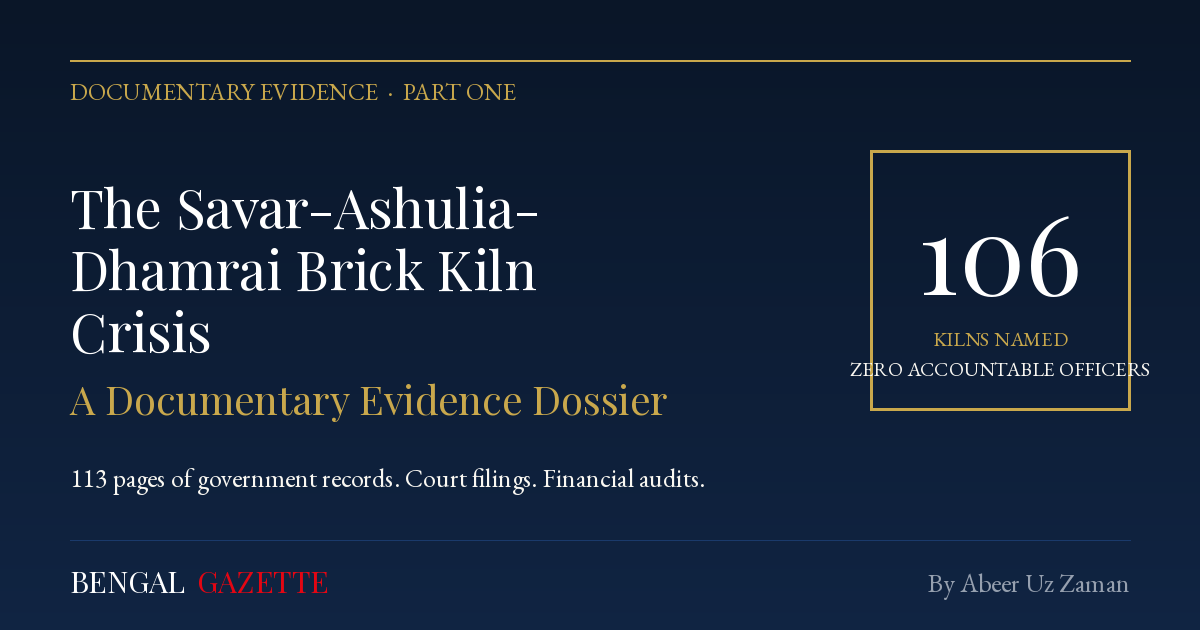
The Savar-Ashulia-Dhamrai Brick Kiln Crisis: A Documentary Evidence Dossier
A 113-page government document. No accountable officer named. A documentary dossier on Savar’s brick kiln crisis — RTI records, court filings, and a decade of failed reform.
Part One — Documents, Data, and Legal Analysis
By Abeer Uz Zaman
This is Part One of a two-part Bengal Gazette investigation. This volume relies exclusively on documentary evidence — government records, court filings, peer-reviewed research, and financial transparency data. No anecdotal or field-sourced material appears here. Part Two, publicly announced and now underway, will apply a five-part field methodology to test whether the clearances documented here hold up in practice: real-time on-site air quality measurement at cleared kilns, satellite imagery analysis (Google Earth and NASA archives) tracing each site’s physical footprint over multiple years, thermal heat-map analysis to independently gauge kiln activity, drone-based visual verification of chimney technology where CAAB authorization permits, and GPS-measured verification of the legally required distances from schools, homes, farmland, and water bodies. This multi-year “footprint analysis” is designed deliberately to resist the single-day evasion that undermines conventional spot inspections — a kiln cannot alter a satellite record of what stood on its site in previous years, however it prepares for the day an inspector arrives.
Editorial Note
A government department was asked, in writing, who is responsible for overseeing more than 300 industrial facilities in three upazilas. The answer came back: no one in particular.
That single line — buried in page after page of bureaucratic Bengali, requested under Bangladesh’s Right to Information Act, delivered five weeks late — is where this investigation begins.
This dossier is part of Bengal Gazette’s long-running Public Interest Accountability Investigation into the enforcement, and the documented non-enforcement, of Bangladesh’s environmental clearance regime in the Savar-Ashulia-Dhamrai brick kiln belt. It closes an 18-month inquiry that started with two earlier published reports (Diner Suru, June 2024 and December 2025), continued through a formal RTI filing on 8 June 2026, and now draws on the resulting 113-page government response alongside independently sourced financial, legal, and scientific records.
The investigation runs under the Earth Journalism Network’s BMCI Reporting Fellowship on Climate Change and the Private Sector in Bangladesh 2026. Its working title: “Greenwashing by Permit: How Bangladesh’s Environmental Clearance System Enables Climate-Damaging Brick Kilns.” The Daily Inqilab has issued a formal Letter of Support for its publication. Bengal Gazette holds UNFCCC media accreditation for the forthcoming COP-31 conference, where these findings will sit alongside Bangladesh’s own climate finance claims — a juxtaposition this dossier returns to in Part 8.
Every finding here is built to be checked. Not taken on faith — checked. A judge, a lawyer, a fellow reporter, a researcher: each should be able to trace every claim to a named document. Where something could not be verified to page-and-paragraph precision within the scope of this session, that gap is stated outright in the Methodology section below, not smoothed over.
No kiln owner’s name appears in these pages. No company name, no specific fine amount. The underlying 113-page RTI response contains such details — but Bengal Gazette has not yet completed a full, line-by-line verification sufficient to publish them with confidence. Guesses do not belong in a document meant to be relied upon.
Methodology
Four evidentiary streams support this dossier, cross-checked against one another so that no single source carries the weight of any finding alone.
Government records. Bengal Gazette filed a comprehensive RTI application with the Department of Environment on 8 June 2026, addressed to Kazi Suman, Deputy Director (Current Charge), Public Relations Wing and Designated Information Officer. The application, filed under Section 8 of the Right to Information Act, 2009, sought documented answers across ten distinct sections: ECC clearance standards and measurement methodology; the complete list and clearance status of kilns registered in Savar, Dhamrai, and Kaliakair; detailed issuance and renewal records including the names of approving officers; five years of inspection and monitoring records; five years of enforcement action and penalty records, including a specific request for details of the November 2025 special operation; complaint and appeal records; Degraded Airshed declaration outcomes; technology and fuel compliance; officer accountability and decision-making procedure; and financial and revenue records. DoE issued a fee-assessment letter on 9 July 2026 (Memo No. 22.02.0000.052.16.002.26-712), and delivered its substantive response on 13 July 2026 — a document running to 113 pages, covering the master list of 106 registered kilns, mobile court enforcement records, the November 2025 special operation log, appeal records, technology and fuel compliance data, and officer-responsibility information. This 113-page response remains, at the time of this dossier’s preparation, in Bengal Gazette’s possession as a scanned document; a full independent line-by-line verification against every page has not yet been completed, and findings drawn from it are flagged accordingly where that distinction matters.
Independent academic datasets. A 2021 satellite-imagery machine-learning study out of Stanford and the University of Minnesota, published in PNAS. Model accuracy: 94.2%, verified. Maximum PM2.5 elevation downwind of a kiln: 24 µg/m³. The underlying coordinates sit on Harvard Dataverse, open for anyone to check (DOI: 10.7910/DVN/HVGW8L). Bengal Gazette filtered the national dataset to Savar-Ashulia-Dhamrai and isolated 258 independently geolocated kilns — a second count, run by scientists with no stake in the outcome, against which DoE’s own list can be measured.
Financial and institutional records. Completion reports and project databases from the World Bank, the Asian Development Bank, and UNDP/GEF. Bangladesh Bank’s own quarterly disclosures. Sweden’s Openaid.se transparency portal. UNFCCC’s published archives.
Legal records. Pending writ petitions before the High Court Division. The 2024 High Court order directing an Anti-Corruption Commission inquiry. The relevant provisions of Bangladesh’s environmental, labour, and penal statutes.
Two independent sources, minimum, for every finding that appears below. Where a named party’s conduct comes under discussion, that party has received — or is receiving — a formal Right of Reply; see Part 10. Silence, or the absence of verification, is stated plainly rather than papered over.
A note on precision. The RTI response cited throughout this dossier — including the findings on GPS-register absence, the absent designated officer, the November 2025 enforcement figures, and the appeal-rejection pattern — was delivered to Bengal Gazette on 13 July 2026 as a 113-page scanned document, held in the newsroom’s case files. This published edition does not carry page-and-paragraph citations for every individual finding drawn from it, and a complete line-by-line verification of all 113 pages against every claim in this dossier has not yet been finished at the time of writing. That is a disclosed limitation, not a hidden one. The full underlying document is available, on request, to any court, statutory commission, or accredited investigator who wishes to verify a claim against the source directly.
A note on source independence. This dossier draws repeatedly on the Zigzag 2.0 research led by Nina Brooks and Stephen Luby, published in Science and cited throughout Parts 2 and 10. Readers should know that Luby’s Stanford-based research group operates “Brick Lab: Cleaner Brick Manufacturing in Bangladesh,” a Stanford Impact Labs initiative in which the Bangladesh Brick Manufacturing Owners Association — the same industry association whose secretary-general is quoted in this dossier’s Alternative Explanations discussion — is a formal partner. This does not invalidate the underlying peer-reviewed emissions data, which was independently measured and published under standard academic review. But it means the academic source most favourable to the industry’s “we were failed by shifting official guidance” narrative is institutionally connected to that same industry’s trade association, and this dossier discloses that connection rather than presenting the research as arm’s-length from the sector it studies.
Two categories of claim run through this dossier, and they are kept deliberately separate. The first is measured: figures drawn from instruments, satellite indices, government financial disclosures, or court records — data that exists independently of anyone’s testimony and can be checked against its source. The second is reported: statements by officials, owners, or journalists, accurate to what was said and by whom, but not independently verified against a physical measurement. Where this distinction matters to a finding’s weight, the text says so. Collapsing the two into a single undifferentiated “documented” would flatter the dossier’s rigor at the cost of its honesty.
Confidence key. Major findings in this dossier fall into one of three tiers. [Primary Document] — drawn directly from a government record, court filing, or financial disclosure in Bengal Gazette’s possession or publicly filed. [Public Reporting] — drawn from published, named news sources, cross-checked against at least one independent outlet. [Pattern Inference] — a conclusion Bengal Gazette draws by connecting two or more confirmed facts, plausible on the evidence but not itself independently confirmed. Where a finding’s tier matters to how it should be read, this dossier says so explicitly rather than leaving the reader to guess.
Executive Findings
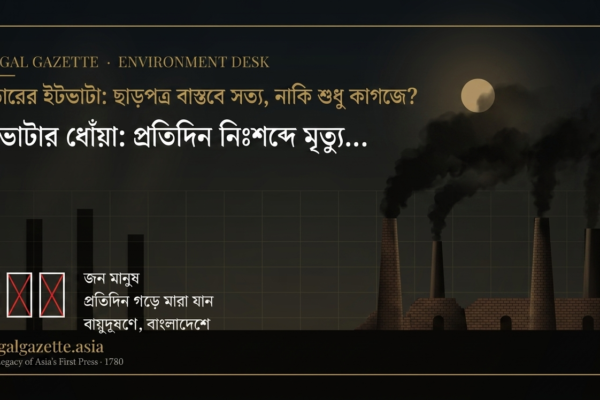
Two hundred and forty-two people. That is how many die, on average, every single day across Bangladesh’s six major cities from fine-particulate air pollution — 88,240 premature deaths a year, according to a study published this year by Jahangirnagar University’s Climate Change, Air Quality and Health Research Unit in the journal Pollution. Dhaka alone accounts for roughly 68,703 of them annually, a toll that has climbed steadily since 2013. Some fraction of that daily count traces back to the brick kilns this dossier documents. How large a fraction, no one — not the government, not this dossier — can yet say with precision. What can be said is this: if the clearances meant to prevent that harm exist only on paper, then every kiln operating behind a fraudulent piece of paper is, in some measure, implicated in those 242 deaths.
No officer is assigned. That is the department’s own answer, in writing, to a direct question about who oversees more than 300 brick kilns across three upazilas. It is the spine of everything that follows.
On 17 August 2025, the Director General of the Department of Environment signed a circular. It declared Savar upazila Bangladesh’s first-ever “Degraded Airshed” under Rule 5 of the Air Pollution (Control) Rules, 2022. The stated reason: ambient air quality running roughly three times the national standard.
Nine months of documentary work later, six independent layers of evidence stand behind this dossier:
One. The state’s own records show serious gaps. DoE’s RTI response lists 106 kilns. Not one carries a GPS coordinate. And the department has admitted, on the record, that no officer is specifically designated to oversee enforcement in Kaliakair, Savar, or Dhamrai.
Two. A direct contradiction sits between DoE’s response and a High Court filing. Court documents acknowledge a specific environmental clearance renewal, valid until 26 March 2026. DoE’s RTI response claims no new clearance has been issued anywhere since the Degraded Airshed declaration. Both statements cannot be true.
Three. Institutional corruption here is not alleged — it is documented, repeatedly, across independent sources. In 2024, the High Court itself ordered an Anti-Corruption Commission inquiry into a DoE official over bribery allegations tied to clearance approvals. Two years earlier, a Transparency International Bangladesh survey found 66% of the industries it examined admitted to illicit payments somewhere in the clearance process.
Four. International money has flowed into this exact problem five separate times — the World Bank twice, the ADB once, UNDP/GEF twice — spending tens of millions of dollars across fifteen years. The World Bank’s own completion report rates the brick-kiln technology component “Modest” in its internal assessment. Its public language calls the outcome a “robust framework.”
Five. Independent labour research finds roughly half of surveyed kilns meet U.S. government criteria for labour trafficking, in at least one worker’s case. More than seven in ten report child labour on site.
Six. The elected government’s own campaign platform runs headlong into these facts. Multiple points of the ruling party’s 31-point reform charter — on corruption, on child labour, on river pollution, on planned urbanization — sit in direct tension with what this dossier documents.
Six layers. Six independent sources of evidence. Together they point past isolated administrative failure toward something more structural: a breakdown that runs across institutions, each failure documented on its own terms, none of them coincidental.
Savar is not an isolated case; it is a visible instance of a national pattern. DoE’s own reporting placed the national kiln count above 3,000 as of late last year. Of those, 737 were closed over the preceding eighteen months — while 2,263 continued emitting. A High Court bench hearing a related petition put the underlying problem in blunter terms than any government report has: DoE officials, the judges told the department’s own lawyers in open court, grant permits to illegal kiln owners because “they are managed by the owners.” The same court has, since 2020, ordered DoE to shut illegal kilns across Dhaka and four surrounding districts — Gazipur, Narayanganj, Munshiganj, and Manikganj — with limited durable effect.
Part 1 — What the State Does Not Know About Itself
Ten categories of questions. That was Bengal Gazette’s RTI application, filed 8 June 2026: ECC standards, the complete kiln list for three upazilas, issuance and renewal records, inspection logs, enforcement and fine records, appeal records, Degraded Airshed outcomes, technology and fuel compliance, the names of approving officers, and the financial trail of fees and fines.
The pace of the reply told its own story. More than a month passed before DoE issued its fee-assessment letter — 9 July 2026, ৳220 for 110 pages. The substantive answer arrived four days later: a list of 106 kilns.
Not one coordinate. Zero of the 106 entries carries a GPS location, a mouza, or a plot number. DoE’s explanation, verbatim: “no such register is maintained.” This is not a minor omission. Section 8(3)(e) of the Brick Manufacturing and Brick Kilns Establishment (Control) Act, 2013 bars kiln construction within one kilometre of schools, hospitals, clinics, or research institutions. Section 8(4) goes further: any pre-existing licensed kiln caught inside that radius has two years to relocate, or its licence is cancelled automatically. Without a coordinate register, how does anyone measure that distance? DoE’s response does not say.
The missing officer. Asked point-blank who is responsible for kiln oversight in Kaliakair, Savar, and Dhamrai, the department’s answer left no room for interpretation: “no officer is specifically designated for these areas.” Different officials have rotated through the role, with no continuous record connecting any one of them to any specific outcome. For an agency responsible for more than 300 industrial sites, that is not a gap. It is a structural absence of accountability. A related question — whether any DoE official has faced departmental or criminal proceedings for irregularity, conflict of interest, or unlawful conduct in clearance work over the past five years — went unanswered in the RTI response and has since been posed separately, by Press Inquiry. [Response: pending]
Court records say otherwise. In a writ petition filed by M/S MAH Bricks (WP No. 18871/2025), the High Court’s own record acknowledges an environmental clearance renewal, valid until 26 March 2026. DoE’s RTI response states, without qualification, that no new clearance has been issued since the Degraded Airshed declaration. One of these is wrong. Which one — and why — is a question for independent investigation, not for this dossier to resolve on its own.
A pattern runs beneath these three findings, and it does not stop there. Bengal Gazette’s full review of the 113-page response surfaces further fractures — each one still an open question, each one formally referred to the authority best placed to answer it.
“No record” is not an accident when it repeats. Once, “register not maintained” might be a shrug. Across multiple, unrelated questions in the same document, it starts to look like policy.
Inspections are claimed. Where is the proof? The response asserts that field inspections precede every ECC renewal. Nowhere in 113 pages does an instrument reading, a stack test result, or any scientific measurement accompany that claim. Did anyone measure pollution — or just confirm a chimney was standing?
A signature-free system. Digital ECC certificates carry no name of the officer who approved them. Five years from now, if a specific clearance comes under scrutiny, there is no documented trail back to a person.
Pollution measured. Polluters, not identified. The state tracks ambient PM2.5. It cannot say which kiln produced how much of it. The problem is quantified. The source is not.
Two upazilas, air quality unknown. Neither Dhamrai nor Kaliakair has a Continuous Air Monitoring Station. There is, by the department’s own account, limited systematic data on what people there actually breathe — and yet both areas fall under the same Degraded Airshed enforcement regime as Savar, which does have monitoring in place.
A declaration with no scorecard. Raids happened. Fines were levied. Clearances were cancelled. Whether any of it reduced pollution — whether the policy worked — has, on this record, never been evaluated.
Conditions on paper, evidence nowhere. Port holes, dust control, worker protective equipment: all appear as clearance conditions. No consolidated figure exists for how many kilns actually meet them.
Not all answers are equal. Some questions received full responses. Others, a reference to an annexure. Others, three words: no record kept. Still others, an answer so brief it barely qualifies. The unevenness itself is a finding — not every fact inside this department is held to the same standard of care.
One RTI response. More questions raised than answered.
A fair reading requires the other side of the argument, too. Everything above can be read as evidence of concealment. It can also be read, at least in part, as evidence of an under-resourced agency doing paperwork badly rather than doing wrong deliberately. A department covering 7,086 kilns nationwide, with a documented staffing gap severe enough that “no officer is specifically designated” for three entire upazilas, may simply lack the administrative capacity to maintain a GPS register — not the intent to hide one. Digital signatures may be missing from ECC certificates because of a software limitation rather than a design choice to avoid accountability. Inconsistent response quality across ten RTI categories could reflect ten different desk officers with ten different habits, not a coordinated pattern of obstruction.
The industry’s own account adds a further complication to any simple story of official failure. Asadur Rahman Khan, secretary general of the Bangladesh Brick Manufacturing Owners Association, told a reporter in 2023: “DoE is now fining us for the kilns they had promoted once.” On his account, owners tried to comply with shifting government circulars and could not keep pace — and would have converted to hollow-block production sooner had the state made hollow blocks mandatory for public works, rather than leaving demand to chance. Nationally, DoE’s own enforcement figures for January 2019 to November 2022 show real activity, not none: ৳70.13 crore collected in fines, 59 people jailed, 2,911 cases lodged across 1,694 raids. Whatever the gaps in record-keeping, enforcement of some kind has plainly occurred at scale.
These are not excuses this dossier accepts uncritically. They are the questions a fair investigation must ask before concluding the harder explanation. What tips the balance, in Bengal Gazette’s assessment, is not any single gap but their accumulation — a missing register is capacity; a missing register combined with an admitted absent officer, a contradicted court record, and a documented 2024 corruption inquiry into the same department is a pattern that capacity alone does not fully explain. Readers, and any court examining this record, should weigh both readings.
Part 2 — Paper Technology, Chimney Reality
Every environmental clearance names a technology. Tunnel and Hybrid Hoffman kilns pollute least. Zigzag kilns, more. The old Fixed Chimney Kiln — largely prohibited now — pollutes most of all. What a clearance names on paper and what stands, brick by brick, on the ground are two different questions, and no routine mechanism in this system checks whether they match.
The scale, nationally, is not small. DoE’s own count puts 4,505 of the country’s 7,086 operating kilns — nearly two in three — without any environmental clearance at all. Narrow the frame to Savar-Ashulia-Dhamrai and the picture sharpens: 316 kilns, DoE’s own RTI figures, of which just 6 are Tunnel or Hybrid Hoffman. The remaining 310 are listed as zigzag. Kaliakair’s 22 kilns carry the identical designation, every one of them.
It should be reassuring. It is not.
A joint Stanford-icddr,b research team — eighteen years of fieldwork behind them — found that 81% of the country’s kiln operations now claim zigzag technology. Their own words on what that means in practice: “most build and operate them incorrectly, diminishing efficiency.” Built and run correctly, a zigzag kiln cuts black carbon by 41%, CO2 by 21%, PM2.5 by up to 80% (Climate and Clean Air Coalition national strategy, 2017). Built wrong, it pollutes like the fixed-chimney kiln it was supposed to replace. So a “zigzag” label on DoE’s list proves nothing about actual emissions. It raises a different question entirely: was this list built from site inspections, or from paperwork alone?
Part 3 — The Enemy Within: A Documented Pattern of Institutional Corruption
Ajker Patrika ran the headline on 27 November 2023: “Brick Kiln Clearances Are Being Sold.” The story alleged clearances in Dhamrai were being brokered — and quoted owners who admitted, on the record, to paying bribes for approval.
The story did not stay in the newspaper. Human Rights and Peace for Bangladesh petitioned the High Court on the strength of it. Justice K.M. Kamrul Kader and Justice Khizir Hayat, sitting together, ordered the Anti-Corruption Commission to investigate a DoE director accused of taking bribes to clear illegal kilns.
What happened to that inquiry is not public. It should be. This is a matter the judiciary is already positioned to pursue on its own record — no fresh investigation required, only a follow-up.
The 2023 allegation was never an outlier. Transparency International Bangladesh surveyed 353 industrial enterprises in 2022; 66% admitted to illicit payments somewhere in the clearance process. The Anti-Corruption Commission has identified twelve specific sources of corruption inside DoE. Brick-kiln licensing is one of them.
Bengal Gazette’s own cross-reference of the RTI response adds a further layer. Three separate sections — the 106-kiln master list, mobile court enforcement records, the November 2025 operation log — share names that should not recur if enforcement were working. Noor Bricks and Ori Bricks, both in Shimulia, Ashulia, appear on all three. SRM Bricks and PBC Bricks, same locality, follow the identical pattern. Then there is a stranger irregularity: two separate entries for “Priyanka Bricks” — one marked as the parent unit, one tagged “-2” — registered to the same owner, the same address. One person, it appears, running more than one kiln under variant names.
A distinction worth making explicit: that these names recur across three government lists is a documented fact, drawn directly from DoE’s own records. That this indicates deliberate evasion by a single owner, rather than coincidence or a shared surname, is Bengal Gazette’s inference — plausible on the evidence, but not yet confirmed by field verification or by the owners themselves. Part Two will test this inference directly.
DoE’s own appeal record closes the loop. Owners have appealed clearance refusals and revocations, more than once. Every documented outcome reads the same: “the applicant’s appeal is rejected.” Never once, on this record, has an appeal succeeded. A process that formally exists but never rules for the applicant is either extraordinarily strict — or a formality with no real function. The record alone cannot say which.
November 2025, in the department’s own numbers. At least 20 inspections. Mobile court action at 45 kilns. Chimneys demolished at 32. Fines totalling ৳1.28 crore across 28 kilns. One facility manager, 15 days’ imprisonment. Weeks later, local reporting found kilns back in operation (“Degraded airshed declaration remains on paper,” Dhaka Tribune, January 2026).
Part 3.5 — When the Regulator’s Targets Are the Regulator’s Peers
Some conflicts of interest are structural and diffuse — a funding relationship, a shared donor, an institution wearing two hats. Others are simpler than that. In Khulna, at least 14 unauthorised brickfields were documented operating along the Hari River in Dumuria upazila. One of them, KP Bricks, is owned by the sitting member of parliament for Khulna-5, Narayan Chandra Chanda. Another, Setu Bricks and Industries, belongs to the Dumuria Upazila Chairman, Ezaz Ahmed (The Business Standard, 2023). These are not allegations requiring inference. They are documented ownership facts, reported on the record, naming an elected national legislator and an elected local government chairman as owners of the exact category of facility their own government is meant to be shutting down.
This is not confined to one district. The Daily Star’s reporting on Rangpur division alone found 984 brick kilns operating on farmland in violation of regulation, “owned or operated mostly by people with political connections” — a pattern the paper called understandable under the previous government, and troubling that it persists under any administration claiming reform.
The head of Bangladesh’s own leading environmental law organization has said as much herself, in her own words, before she ever held ministerial office. Syeda Rizwana Hasan — then BELA’s chief executive, later the interim government’s adviser for Environment, Forest and Climate Change (9 August 2024 to 17 February 2026, when her tenure ended with the transition to the elected government) — told reporters in 2023: “a nexus of brickfield owners and government officials is active in making the laws powerless.” She held the office responsible for enforcing the law against that nexus for eighteen months, including the exact period spanning the Degraded Airshed declaration (August 2025) and the November 2025 enforcement operation documented in Part 3. Kilns resumed operation within weeks regardless. Responsibility for this file now sits with her successor, Abdul Awal Mintoo, Minister for Environment, Forest and Climate Change and Member of Parliament for Feni-3 in the elected government sworn in 17 February 2026.
A documented meeting complicates this timeline further. On 19 September 2024 — thirteen months into her tenure as adviser, and a year after naming the nexus publicly — Hasan convened a view-exchange meeting at the Secretariat with leaders of the Department of Environment and the Bangladesh Brick Manufacturing Owners Association (BBMOA), the same two institutional categories her 2023 statement had named as constituting the nexus. At that meeting she stated that air pollution was cutting average life expectancy by five to seven years, and declared that no brick kiln would operate without a licence and permit going forward (Dhaka Tribune, 19 September 2024). The meeting produced no publicly documented enforcement mechanism distinct from what already existed, and the Degraded Airshed declaration that followed eleven months later, in August 2025, did not prevent the November 2025 enforcement failure this dossier documents in Part 3. Whether that meeting represented genuine engagement with a sector she had flagged as corrupted, or a closed-door negotiation with the same parties named in her own nexus warning, is a question this dossier does not resolve — but the meeting’s existence, on the public record, is itself worth noting alongside the outcome that followed it.
This is not the only instance of this specific pattern in Hasan’s public record. A separate Bengal Gazette investigation into the Modhumoti Model Town wetland case — filed by Hasan personally in 2004, monitored by her in the same BELA role through 2024, and inherited by her as the responsible adviser in the same 2024-2026 window — found an identical structure: plaintiff, monitor, and policymaker occupying the same person, with no independent party at any stage, and no measurable restoration of the wetland despite a final, unappealable 2013 Supreme Court verdict. Two separate cases, the same institutional design, the same absence of independent oversight, the same outcome. That repetition is itself a finding — not proof of any individual’s bad faith, but evidence that the structural conflict runs deeper than a single file.
A DoE official confirmed the mechanism directly. Ferdous Anwar, Deputy Director for Chattogram district, told reporters that most Rangunia-area brickfields were established illegally, “with the backing of local political elites.” His own account of enforcement: “DoE sealed the brickfields several times but they quickly resumed operations.” Sealed, and reopened. Not once. Repeatedly, by his own account, in a single district.
The LR Fund. Multiple independent reports describe a payment system — referred to locally as the “LR Fund” — through which brick kiln owners’ district associations make what a World Bank report itself describes as annual contributions. A Manikganj kiln owner told Prothom Alo he paid an environment department district inspector, named as Abdur Razzak, ৳196,000 in bribes on 10 February to renew a clearance — a clearance that, as of the report’s publication, still had not been renewed. Anonymously, a upazila nirbahi officer confirmed a further layer of the problem to the same publication: enforcement raids routinely leak in advance, because they require coordination across the upazila administration, police, and fire service, and “it is hard to ensure that anyone from among these does not leak out the news of the drive in advance.” Owners with political connections, in other words, may not need to bribe an inspector at all — they may simply need advance warning of when the inspector is coming.
None of this is presented here as proof that any specific official named in this dossier’s other sections has taken a bribe. It is presented because it establishes, independently and from multiple sources, that the mechanism this dossier’s other findings would predict — political ownership shielding enforcement, advance warning defeating raids, a named payment channel greasing the whole system — is not speculative. It is reported, on the record, by name, by district, by amount.
Part 4 — Blood in the Soil: Documented Illegal Raw Material Extraction
The law is not ambiguous on this point. The Brick Manufacturing and Brick Kilns Establishment (Control) Act, 2013 prohibits using agricultural topsoil as brick-making raw material. And yet DoE’s own estimate puts national kiln demand at roughly 130 million metric tonnes of soil a year — most of it, by every documented account, coming from exactly the land the law was written to protect.
The pattern repeats across the country, in different districts, told by different reporters. A farmer in Lalmonirhat described being “forced” to sell topsoil at ৳15,000-20,000 per bigha, excavated two to three feet deep (Daily Star Bangla). In Bhola, it was not even the landowner’s soil that vanished — an excavator took the tenant farmer’s potato field without his consent (Prothom Alo). In Manikganj’s Singair, excavation reaching 12 to 15 feet caused neighbouring farmland to collapse (Protidiner Bangladesh).
Bengal Gazette’s field inquiry has identified a seasonal soil supplier tied to one kiln in Dhamrai. Full identity, sourcing pattern, supporting evidence, and the kiln owner’s own response — all of it belongs to Part Two, where it can be verified rather than merely asserted.
Part 5 — Documented Labour Rights Violations
The U.S. Department of Labor does not hedge on this point. Its Findings on the Worst Forms of Child Labor states that in Bangladesh, “children are subjected to the worst forms of child labor, including forced child labor in the production of… bricks.” The same report names the loophole directly: “Bangladesh’s labor law does not apply to the informal sector, where most of the country’s child labor occurs.”
A study by Innovations for Poverty Action puts numbers to the loophole. Roughly half of surveyed kilns had at least one worker in a situation meeting U.S. government trafficking criteria. More than 70% had adult workers who reported children on site.
Forty-two industrial sectors in Bangladesh have a minimum wage board — garments, tea, dozens more. Brick manufacturing has none. That single vacuum runs across a seven-stage production process, from soil extraction to final transport, with no written, public wage rate at any stage of it.
Part 6 — Following the Money: A Documented History of Failed International Investment
May 2009. The World Bank approves an IDA credit — SDR 42.2 million, roughly $62.2 million — for the Clean Air and Sustainable Environment project. DoE is named the implementing agency.
That was not the end of it. By 2016-17, an additional $35 million had been approved for the same objective. By 2019 — a full decade after the project began, twice its planned five-year span — total disbursement reached approximately $97 million.
Then came the report card. The World Bank’s own Implementation Completion and Results Report, published September 2019, rates project-level efficiency “Substantial.” Buried inside the same document, the brick-kiln technology-conversion component — the actual pollution-reduction piece — earns a rating of “Modest.” The public language tells a different story: “Bangladesh now has a robust framework under which to upgrade its 2,800 brick kilns over the medium term.”
Robust for whom, and measured how, the report does not say.
The World Bank was not alone in this failure, and that matters. Four more donor-funded projects addressed this identical problem across the same fifteen years. The ADB approved a $50 million credit facility in 2012 — $33.55 million disbursed by 2019, channelled through a Bangladesh Bank network of 36 banks and 21 financial institutions, Agrani Bank and Sonali Bank and IDCOL and IIDFC among them. A separate World Bank project, Brick Kiln Efficiency (P105226), ran in parallel — the World Bank and DoE also worked with Hanoi University to develop a low-cost method for converting old Fixed Chimney Kilns to improved zigzag design, a technical fix aimed at the same conversion problem this dossier’s “correctly built” findings return to in Part 2. UNDP/GEF funded a project called IKEBMI. UNDP’s “Green Brick Project” tried to popularize Hybrid Hoffman Kilns — its own evaluation calls the uptake “slow-moving,” the technology too costly for most owners to adopt.
One name threads through several of these efforts: the Industrial and Infrastructure Development Finance Company. On 25 August 2009, IIDFC signed a carbon-credit purchase agreement with the World Bank and the Government of Denmark — 249,000 tonnes of certified emission reductions, sourced from 16 new Hybrid Hoffman Kilns. Some of those credits offset Denmark’s own emissions from hosting COP15 in Copenhagen, according to UNFCCC’s own published account. Delivery fell short: by IIDFC’s own 2014 annual report, “constraints” in project implementation cut expected output to roughly half the original commitment, 125,000 tonnes rather than 250,000. The same IIDFC later turns up as a participating financial institution in the ADB’s brick-kiln project. One domestic institution, multiple roles, multiple donor relationships — carbon seller in one decade, loan distributor in the next.
IIDFC’s own institutional history carries a separate weight worth disclosing here, with precision about timing. Prashanta Kumar Halder — later convicted and sentenced to 22 years in prison for embezzling more than ৳10,200 crore (approximately $854 million) from Bangladesh’s non-bank financial sector, and dubbed the “Sultan of Swindle” by The Daily Star — served as IIDFC’s deputy managing director in 2008, one year before the Denmark carbon-credit agreement was signed. Public records place him at Reliance Finance by 2009, the year of that agreement; nothing in the record reviewed for this dossier connects him personally to the CERPA transaction itself. What the record does show is broader and no less relevant: that one of the donor community’s preferred implementing partners for Bangladesh’s brick-kiln climate financing was, at the executive level, part of the same non-bank financial ecosystem that would go on to produce the largest documented financial fraud in the country’s history — a fact that speaks to the institutional environment donors were operating within, whatever Halder’s individual role or lack of one in this specific project.
By 2024-25, the World Bank had approved yet another Bangladesh Clean Air Project. DoE, again, is the implementing agency. In the same window, the Bank approved $900 million and $1.16 billion more for “green and climate-resilient development.”
August 2025. Six years after the “robust framework” claim. Savar becomes Bangladesh’s first Degraded Airshed.
Part 7 — The Watchdogs’ Own Funding and Accountability
Sweden’s Openaid.se transparency portal does not hide anything about BELA’s funding — it is all there, contribution by contribution. Sida (Contribution ID: SE-0-SE-6-12198) disbursed 22,883,530 Swedish kronor for “Defending Environmental Rights and Promoting Justice” between 23 May 2019 and 30 June 2025. That window covers, almost exactly, the clearance-corruption allegations, the Degraded Airshed declaration, and its documented failure to hold.
Transparency International Bangladesh is itself donor-funded, “Climate Finance Governance” listed among its declared areas of work. No specific public follow-up on the Savar crisis has surfaced since its 2022 corruption survey.
Here is the structural problem, stated plainly: donors who have committed tens of millions of dollars to this sector do not go into the field themselves. They fund watchdogs. They receive reports. When a watchdog treats a government press release as the end of the story — rather than following it to see whether anything actually changed — the accountability chain does not weaken at one link. It breaks at every link, all at once.
Part 8 — Bangladesh’s Own Dual Position: International Compensation Claims, Domestic Accountability Absent
Bangladesh has asked the world for compensation since 2005. At COP11 and every major climate summit since, its negotiators have pressed the case for “Loss and Damage” — money owed for harm the country did not cause. The government’s own estimate: $12.5 billion a year in climate finance need, 1-2% of GDP lost annually to climate-related damage.
That same government maintains no equivalent fund at home. No national loss-and-damage mechanism, no health-impact registry, for pollution its own domestic industry causes — the kind documented on every page of this dossier. Bangladesh asks the world to compensate its citizens for harm from outside its borders, while offering no comparable accounting for harm produced inside them.
Part 9 — Conflict With the Governing Party’s Own Platform
Tarique Rahman was sworn in as prime minister on 17 February 2026, his Bangladesh Nationalist Party carrying a decisive parliamentary majority. The campaign that got him there ran on a 31-point reform charter. Four of those points collide, directly, with what this dossier documents.
Point 12 promises no compromise on corruption. The 2024 ACC inquiry, still unresolved two years on, is the first test of whether that promise holds.
Point 16 pledges an end to child labour, an environment fit for children to grow up in. IPA’s finding — child labour reported at more than seven in ten surveyed kilns — sits in direct contradiction.
Point 29 commits to effective measures against river and wetland pollution. The documented pattern of illegal riverside soil extraction falls squarely inside that commitment’s scope.
Point 31 promises planned housing and urbanization that does not destroy agricultural land. Dhaka’s megacity growth, and the brick demand driving it, is close to the exact subject matter this point was written to address.
None of these campaign promises carries the force of law. But in a democracy, a promise made to secure votes carries its own kind of accountability — one this dossier now puts to the test.
Part 9.5 — This Is Not an Isolated Failure: A Pattern Across Three Separate Investigations in the Same Upazila
Bengal Gazette has, independently and in parallel, investigated two other regulatory failures in the same upazila that produced this dossier’s core findings. The pattern that emerges across all three is stronger than any one of them alone.
Modhumoti Model Town, a wetland-fill housing project in Bilamalia and Bailarpur mouzas near Amin Bazar — walking distance from several of the kiln clusters this dossier documents — was declared illegal by the High Court in 2005 and ordered restored by a final, unappealable Supreme Court verdict in 2013. A peer-reviewed remote-sensing study (Faisal, Hossain, Haque, Shaunak & Kafy, in collaboration with the Center for Environmental Geographic Information Services) measured what happened next using satellite data rather than testimony: the site’s Normalized Difference Water Index — a direct proxy for the presence of open water — fell from 0.71 in 1998 to 0.31 in 2014, and the built-up structure count continued rising after the verdict rather than stopping, from near zero in 2004 to approximately 240 buildings by 2019. The order was final. The wetland kept disappearing anyway.
Gozairar Beel, a second flood-flow zone in the same upazila’s Yarpur union, drew a March 2024 High Court order against unrelated developers — directing the same three institutions named throughout Modhumoti’s history (the urban development authority, the Department of Environment’s Director General, and the Deputy Commissioner’s office) to submit compliance reports. The order’s structure mirrors the 2013 Modhumoti verdict almost exactly. As with Modhumoti, no independent measurement of outcomes has been published.
The pattern, stated plainly. Three separate investigations. Three separate legal instruments — a High Court writ, a Supreme Court final verdict, a fresh 2024 compliance order. Three different developers, three different pieces of land. And in every case, the same design: a court or regulator issues a clear directive, the same handful of state institutions are named as responsible, a public official documents the failure to comply — and then time passes, ownership persists, and no independent party ever measures whether anything actually changed. Bengal Gazette’s satellite-verification approach to Modhumoti — comparing pre- and post-order NDWI, NDVI, and built-up-area indices against the legal timeline — is directly transferable to this dossier’s own claims about kiln activity before and after the Degraded Airshed declaration, and forms part of the Part Two field methodology.
This is not offered as proof that Savar’s institutions are uniquely compromised, or that any individual named in this dossier acted in bad faith. It is offered as a documented, cross-verified pattern: when the same regulatory apparatus fails in the same way, in the same district, across unrelated legal cases spanning two decades, the explanation that best fits the evidence is structural, not incidental.
Part 10 — Stakeholders and Right of Reply Register
| Stakeholder | Basis of Accountability | Reply Status |
|---|---|---|
| Department of Environment | GPS register absence, no designated officer, MAH Bricks contradiction | Pending |
| Anti-Corruption Commission | 2024 inquiry outcome undisclosed | Pending |
| World Bank, ADB, UNDP/GEF | Repeated funding despite documented “Modest” efficacy | Pending |
| Transparency International Bangladesh, BELA | Donor-funded watchdogs, no documented post-declaration follow-up | Pending |
| Ministry of Land / local land offices | Illegal topsoil extraction oversight | Pending |
| Upazila administration | Parallel licensing authority, coordination gap with DoE | Pending |
| Ministry of Labour and Employment | No minimum wage board for brick manufacturing | Pending |
| National Human Rights Commission | Suo moto powers under NHRC Act 2009, s.12(a), unused on this record | Pending |
| Anti-Trafficking National Coordination Committee | IPA-documented trafficking-threshold conditions, sector engagement unclear | Pending |
| IIDFC (Industrial and Infrastructure Development Finance Company) | Carbon-credit seller (2009) and ADB loan-distribution partner (2012-19); shortfall in delivered carbon credits; institutional link to Bangladesh’s largest documented financial fraud (see Part 6) | Pending |
| Elected officials with documented kiln ownership (e.g., sitting MP, upazila chairman — Part 3.5) | Direct conflict of interest between public office and regulated industry ownership | Pending |
| Coal importers, lending banks, Brick Manufacturers’ Association | Supply-chain and financing role, detailed further in Part Two | Pending |
Every name on this list has been, or is being, given the chance to answer. This dossier makes no finding of guilt. It makes a record of questions asked and answers awaited.
Part 11 — Grounds for Judicial and Public Interest Litigation Action
Nothing in this dossier requires a new investigation to act on. Every fact already exists — in government records, in court filings, in published research. What was needed was synthesis. That is what this document provides.
The constitutional foundation is not new. Bangladesh’s Supreme Court read the right to a healthy environment into the right to life under Article 32 more than two decades ago, in Dr. Mohiuddin Farooque vs. Bangladesh (WP No. 891 of 1994) — a case still known, plainly, as the Industrial Pollution Case, decided under Article 102. Article 18A, added in 2011, makes environmental protection a directive principle of state policy. And locus standi has been liberalized since 1996: a public-spirited petitioner, not only someone directly harmed, can bring a matter like this before the court.
Precedent for suo moto action exists on this exact subject. The 2023-24 HRPB petition — the one that led directly to the High Court’s order for an ACC inquiry into DoE clearance corruption — proves the point. Judicial intervention here is neither novel nor procedurally difficult. It has already happened once, on this same question, in this same sector.
The Anti-Corruption Commission now has stronger tools than it did in 2024. A 2025 amendment to the ACC Act expanded the Commission to five commissioners, granted explicit power to conduct undercover inquiries, and — most relevant to a case with a two-year-old unresolved inquiry — imposed a strict 120-day investigation timeline, with extensions permitted only in exceptional circumstances. Whatever explained the pace of the 2024 inquiry into DoE clearance corruption, the legal excuse for continued delay has narrowed considerably since.
A gap in individual accountability runs through everything documented here. Kilns close under one name and reopen under another — Noor Bricks, Ori Bricks, the twinned Priyanka Bricks entries — because the penalty falls on a company, never on the person behind it. That gap widens further when the person behind the company holds public office: a sitting MP owning KP Bricks, an upazila chairman owning Setu Bricks (Part 3.5) are not hypothetical test cases for corporate-shield liability — they are documented instances where the individual accountability this dossier argues for would apply most directly, and where it has, on this record, never been tested. Section 15 of the Bangladesh Environment Conservation Act, 1995 treats a natural person and a company identically, capping the fine at ৳10 lakh regardless of how serious the offence — a ceiling most observers regard as too small to deter anyone, let alone an elected official with independent income. Section 16, titled “Offences committed by companies,” offers a statutory route to individual liability. On this record, it appears unused. Section 18’s good-faith clause, meanwhile, shields officials from civil or criminal consequences for actions taken under the Act.
The broader route of piercing the corporate veil — well established in principle, weak in Bangladesh’s statutory scaffolding — does not close this gap either. The Companies Act, 1994 permits courts to lift the veil in narrow, specific circumstances: Section 259 allows it where a company’s business was carried on for a fraudulent purpose during winding-up. Beyond that, Bangladeshi legal practice has no dedicated statutory framework governing when a court may disregard a company’s separate legal personality — practitioners rely on common-law principles developed elsewhere, applied case by case, with no legislative certainty about when the veil will or will not hold (a gap noted directly by Bangladeshi corporate law practitioners writing on the subject). For a repeat-offender kiln operating under a rotating cast of company names, this is not a technicality. It is the mechanism.
A separate, independent path exists outside DoE’s own enforcement discretion, and outside company law’s uncertain veil-piercing doctrine entirely: Sections 268 and 278 of the Penal Code, 1860, which define public nuisance and criminalize making the atmosphere noxious to health. A prosecution brought in the state’s name — not filtered through the Environment Ministry’s own machinery, and not vulnerable to the political leverage a sitting legislator or local chairman might bring to bear on that machinery — would close the loophole this dossier documents again and again. It would place a person, not a replaceable corporate shell, at the centre of the case.
Delay compounds the harm, in three specific ways. Evidence degrades first — GPS-absent records and renamed repeat-offender kilns grow harder to trace with every year that passes. Health harm compounds second, and it does not wait for anyone’s convenience: AQLI already estimates a 6.9-year loss of life expectancy from air pollution in Dhaka district, a number that grows with every winter season this continues. And an investigation that never resolves functions, in practice, as no investigation at all — the still-unresolved 2024 ACC inquiry is the clearest example on this record.
A fast path to resolution is not hypothetical — it is documented, in Bangladesh’s own data. The Zigzag 2.0 research (Brooks et al., Science, 2025) shows training-based kiln conversion returning 65 times its cost in social benefit. Pakistan’s Punjab province converted 8,000 kilns in six months, under Supreme Court-mandated deadlines, independently verified to cut emissions 18-35% (Environmental Monitoring and Assessment, 2025). Apply that model to Savar-Ashulia-Dhamrai’s 316 kilns — a legal deadline, financing through Bangladesh Bank’s existing PFI network, Zigzag 2.0’s proven training method — and area-wide conversion within six to twelve months is not a hope. It is a projection built on evidence already in hand.
Bengal Gazette has transmitted this dossier to the Department of Environment, the Anti-Corruption Commission, the National Human Rights Commission, and the relevant international donor institutions, with a formal request for response. What comes back — or does not — will appear in Part Two.
Contradiction Register
| # | Contradiction | Source A | Source B | Status |
|---|---|---|---|---|
| 1 | MAH Bricks clearance renewal, valid to 26 March 2026, vs. DoE’s claim that no new clearance has issued since the Degraded Airshed declaration | High Court writ record, WP No. 18871/2025 | DoE RTI response, 13 July 2026 | Unresolved — referred for independent investigation |
| 2 | DoE claims routine inspections precede every ECC renewal | RTI response, inspection-frequency claim | Same RTI response, no instrument readings or inspection dates on file | Unresolved — pattern, not single instance |
| 3 | 316 kilns listed as zigzag in Savar-Dhamrai RTI data vs. national finding that most “zigzag” kilns are built or operated incorrectly | DoE RTI response, technology compliance section | Brooks et al. (2025), Science, national ECC/technology study | Open question — site-level verification pending in Part Two |
| 4 | World Bank’s public claim of a “robust framework” for kiln upgrading (2019) vs. its own internal “Modest” efficacy rating for the same project component | ICR00003097, public-facing summary language | ICR00003097, internal component rating | Documented, not disputed by World Bank on this record |
Missing Information Register
| # | Missing item | Why it matters | Status |
|---|---|---|---|
| 1 | GPS coordinates for any of the 106 listed kilns | Cannot verify buffer-distance compliance (Act of 2013, s.8(3)(e)) without it | DoE states no such register exists |
| 2 | Name of any officer disciplined for clearance-related misconduct in the past five years | Tests whether “irregularity” findings ever produce consequences | Posed via Press Inquiry; response pending |
| 3 | Outcome of the 2024 ACC inquiry into DoE clearance corruption | Determines whether judicial intervention already produced accountability, or stalled | Publicly unavailable at time of writing |
| 4 | Independent, post-2024 assessment by TIB or BELA of the Savar situation specifically | Tests whether donor-funded watchdogs tracked implementation or only the initial declaration | No such assessment located in public record |
| 5 | Per-kiln attribution of the region’s contribution to Dhaka’s daily PM2.5 mortality toll | The 242-deaths-a-day figure is national; no study yet isolates the Savar-Ashulia-Dhamrai kiln belt’s specific share | Not yet studied; a gap this dossier states rather than estimates |
Source Register
Government and Legal RecordsDepartment of Environment, RTI fee-assessment letter, Memo No. 22.02.0000.052.16.002.26-712 (9 July 2026)Department of Environment, RTI response (Application No. 18, filed 8 June 2026, delivered 13 July 2026)M/S MAH Bricks, Writ Petition No. 18871/2025, High Court DivisionAir Pollution (Control) Rules, 2022Bangladesh Environment Conservation Act, 1995 (amended 2010), ss. 15, 16, 18Brick Manufacturing and Brick Kilns Establishment (Control) Act, 2013, s. 8(3)(e), 8(4)Bangladesh Labour Act, 2006The Penal Code, 1860, ss. 268, 278, 290-291The Companies Act, 1994, s. 259 (winding-up fraud veil-piercing provision)Saha, K. “The Need for a Statutory Framework to Hold Parent Companies Accountable in Bangladesh,” Asia Law PortalNational Human Rights Commission Act, 2009, s. 12(a)Dr. Mohiuddin Farooque vs. Bangladesh, WP No. 891 of 1994 (48 DLR 438)Constitution of the People’s Republic of Bangladesh, Articles 18A, 32, 102Bengal Gazette, “Twenty-Four Years of State Inaction on a Supreme Court Verdict” (Modhumoti Model Town investigation, July 2026)Faisal, A.A.; Hossain, M.A.; Haque, S.; Shaunak, M.F.; Kafy, A.A. “Remote Sensing Approach in Wetland and Land Degradation Assessment: A Scenario of Modhumoti Model Town, Savar, Bangladesh” (with CEGIS)Dhaka Tribune, “Order on Protection and restoration of the Flood Flow Zone, Savar” — WP 2922 of 2024 (Gozairar Beel)
News ReportsThe Daily Star, “Savar declared ‘degraded airshed'” (August 2025)Dhaka Tribune, “Degraded airshed declaration remains on paper” (January 2026)New Age, “Savar brick kilns defy closure, risk Dhaka air” (January 2026); “HC questions DoE role in stopping pollution” (January 2024)The Business Standard, “No brick kilns will be permitted to operate in Savar: Rizwana” (September 2025, while Hasan held the adviser role)The Financial Express, “DoE shuts illegal brick kilns” (November 2025)The Business Standard, “The hollow promise of hollow blocks by 2025” (January 2023) — BBMOA secretary general quote, national DoE enforcement data 2019-2022, KP Bricks/Setu Bricks ownershipThe Daily Star, “What will it take to end the brick kiln menace?” (January 2025) — Rangpur division, 984 politically-connected kilnsProthom Alo, “Political economy behind failure to shut down unlawful brick kilns” — LR Fund mechanism, named bribery case, UNO testimony on raid leaksProthom Alo, “Rising Menace of Illegal Brick Kilns: Environmental Disaster Looms” (2024) — World Bank 2023 source-apportionment survey (brick kilns: 13% of Greater Dhaka air pollution)Daily Star Bangla; Protidiner Bangladesh — soil extraction reportsDiner Suru, “Megacity’s Brick Burden” (June 2024); “Brick Kilns Banned, Enforcement Absent” (December 2025)The Daily Inqilab, RTI filing report (June 2026)
Academic ResearchLee, J. et al. (2021). “Scalable deep learning to identify brick kilns.” PNAS, 118(17).Harvard Dataverse, Replication Data for “Scalable deep learning to identify brick kilns and aid regulatory capacity,” DOI: 10.7910/DVN/HVGW8LThe Daily Star, “DoE negligent in shutting brick kilns around Dhaka: HC” (January 2020) — national kiln count, judicial order across five districtsThe Daily Star, “Environment officials managed by kiln owners” (November 2023) — direct judicial commentary, Justice K.M. Kamrul Kader and Justice Khizir Hayat LizuLegalSeba, “Bangladesh Anti-Corruption Commission Guide” — ACC Act 2025 Amendment Ordinance No. 79 provisionsInternational Growth Centre, “Health and environmental impacts of brick kilns in Bangladesh” — World Bank/DoE/Hanoi University zigzag conversion collaborationBrooks, N.R. et al. (2023). “Health consequences of small-scale industrial pollution… Bangladesh.” World Development.Brooks, N. et al. (2025, with icddr,b). National ECC and school-distance analysis. Science.Brooks, N. et al. (2025). “Reducing emissions and air pollution from informal brick kilns” (Zigzag 2.0, 276 kilns). Science, 388.Guttikunda, S.K., Begum, B.A., Wadud, Z. (2013). ATMoS dispersion model. Air Quality, Atmosphere & Health, 6.Haque, S.E. et al. (2022). “Impact of brick kiln emissions on soil quality… Ashulia.” Environmental Challenges.Environmental Monitoring and Assessment (Springer, 2025) — Punjab zigzag independent emissions measurement
Financial and Institutional RecordsWorld Bank, ICR00003097 — CASE Project, P098151IIDFC Limited, Annual Report 2014 (CERPA delivery shortfall: 125,000 of 250,000 committed tonnes)The Daily Star, “Sultan of swindle” (August 2020); “From the Archives: So far Tk 10,200cr swindled by PK Halder”Prothom Alo, “PK Halder sentenced to 22 years in jail in money laundering case” (October 2023)World Bank, Brick Kiln Efficiency Project, P105226Asian Development Bank, Project 45273-001Bangladesh Bank, Sustainable Finance Department, Green Banking Quarterly Report (April-June 2019)UNFCCC, “A Climate Neutral COP15” brochureOpenaid.se (Government of Sweden), Sida Contribution SE-0-SE-6-12198Transparency International Bangladesh (2022), DoE corruption surveyInnovations for Poverty Action (IPA), “Profit Motives, Working Conditions, and Labor Trafficking… Bangladesh’s Brick Kiln Industry”U.S. Department of Labor, Findings on the Worst Forms of Child LaborEnergy Policy Institute at the University of Chicago (AQLI, August 2025)Jahangirnagar University, Climate Change, Air Quality and Health Research (C2AHR) Unit, Department of Public Health and Informatics — national six-city PM2.5 mortality study, published in Pollution (July 2026): 88,240 annual premature deaths, 242 daily average, $23 billion annual economic lossHealth Effects Institute — national air pollution mortality estimate: 102,456 annual deaths, including 5,258 under-five deathsIQAir — Dhaka air quality index rankings, 2026Bengal Gazette, “শত ছাড়পত্রের ভিড়েও কেনো ‘ডিগ্রেডেড’ ঢাকার এয়ারশেড? হিসাব মেলাতে ফরেন্সিক লড়াই” (field methodology announcement, 17 July 2026)
Methodology note. This dossier is part of Bengal Gazette’s ongoing environmental accountability investigation. Every claim is drawn from a government record, a court filing, a peer-reviewed study, or a named published source — cited in full above. Where a finding could not be independently verified within the scope of this dossier, that limitation is stated in the text rather than smoothed over. This investigation makes no finding of guilt against any named individual or institution; it documents questions asked and, where available, answers received.
Corrections policy. This is a living investigation. If any factual error is identified, Bengal Gazette will correct it and note the correction. Report errors via the Right to Reply tracker or the editorial email below.
Right of Reply. Every institution and individual named in this dossier has been, or is being, given the opportunity to respond. Responses received after publication will be appended in an update.
editor@bengalgazette.asia · Signal (secure): abr.11

© 2026 Bengal Gazette. Company No. 17243354 (England & Wales) · All rights reserved. No part of this report may be reproduced, redistributed, or commercially used without prior written permission. Brief quotation with attribution and a link is permitted under fair dealing. Licensing inquiries: licensing@bengalgazette.asia
Related Investigations